


Exposure and Response Prevention (ERP) Therapy
Break Free from the Cycle of OCD with Effective Approach
Available in-person in Calgary and virtually across Alberta.
OCD can be exhausting in ways others may not see. You might find yourself checking, seeking certainty, or performing visible or mental rituals to ease the distress of unwanted thoughts. ERP therapy offers a structured way to change this cycle, helping you respond differently to fear and uncertainty so OCD has less control over your life.
What Is Exposure and Response Prevention Therapy?
Exposure and Response Prevention therapy is a specialized type of Cognitive Behavioural Therapy used in the treatment of OCD.
In ERP, you’ll gradually practise facing the thoughts, situations, and uncertainties that trigger your OCD without relying on checking, rituals, avoidance, reassurance or mental reviewing.
Together, we’ll explore how OCD shows up for you and choose a manageable place to begin. Each step is planned together to help you tolerate discomfort without letting compulsions take over


Is This How You Feel?
You might recognize yourself in some of these experiences:
You keep checking something, even when you've already checked it.
A small doubt can stay with you for hours or longer.
You often feel that you need to be completely certain before you can move on.
You ask other people for reassurance but the relief doesn't seem to last.
You search online or repeatedly go over information to find the answer you need.
You replay conversations, memories, or situations in your mind.
OCD can look very different from one person to another. Some compulsions are easy to notice, while others are private and happen internally.
If you feel as though OCD is beginning to make too many decisions for you, ERP therapy may be a place to start taking some of that space back.
How Can ERP Therapy Help You?
ERP focuses on the part of the OCD cycle that happens after a trigger appears. A thought, doubt, feeling or situation may still create discomfort. But instead of immediately trying to make that discomfort disappear, therapy helps you practise a diff erent response. Over time, you can begin to learn that uncertainty does not always need to be solved and that an intrusive thought does not automatically require action.
Depending on what you're experiencing, ERP may help you:
Understand your personal OCD cycle more clearly
Notice compulsions that may have become automatic
Gradually reduce avoidance
Recognize mental rituals as well as visible behaviours
Reduce repeated checking and reassurance-seeking
Become more able to tolerate uncertainty
The work can be challenging at times because you're learning to do something different from what OCD has taught you to do. But challenging doesn't have to mean overwhelming. The process is structured, purposeful, and adjusted to your individual needs.

Why Choose ERP for OCD?
Many people with OCD have already tried to think their way out of the problem. They may have spent hours looking for reassurance, analysing their fears, searching for certainty, or reminding themselves that everything is probably okay.
The difficulty is that OCD often asks for more. One answer can lead to another question. One reassurance can bring relief for a while, only for the doubt to return later.
ERP takes a different direction. Rather than trying to provide OCD with the perfect answer, the work focuses on reducing the need to keep answering it.
Over time, this can mean:
Less time spent on rituals
Fewer decisions driven by fear or doubt
Less dependence on reassurance
Greater flexibility in everyday life
More confidence in your ability to handle uncertainty
ERP is widely recognized as an effective treatment for OCD and has a strong research base supporting its use.

We start by getting a clearer picture of how OCD shows up for you. From there, we create a plan. You don't have to begin with the hardest thing on your list.
ERP usually involves building gradually, starting with steps that are challenging enough to be meaningful but realistic enough to practise.
Some of the work may happen during our sessions, while some may continue in everyday life between appointments. The goal is not to perform exercises perfectly. It's to give yourself opportunities to practise responding differently and to learn from those experiences over time.


What Does ERP Therapy Actually Look Like?
What Does ERP Therapy Actually Look Like?
We start by getting a clearer picture of how OCD shows up for you. From there, we create a plan. You don't have to begin with the hardest thing on your list.
ERP usually involves building gradually, starting with steps that are challenging enough to be meaningful but realistic enough to practise.
Some of the work may happen during our sessions, while some may continue in everyday life between appointments. The goal is not to perform exercises perfectly. It's to give yourself opportunities to practise responding differently and to learn from those experiences over time.
REGISTERED PROVISIONAL PSYCHOLOGIST | CANADIAN CERTIFIED COUNSELLOR
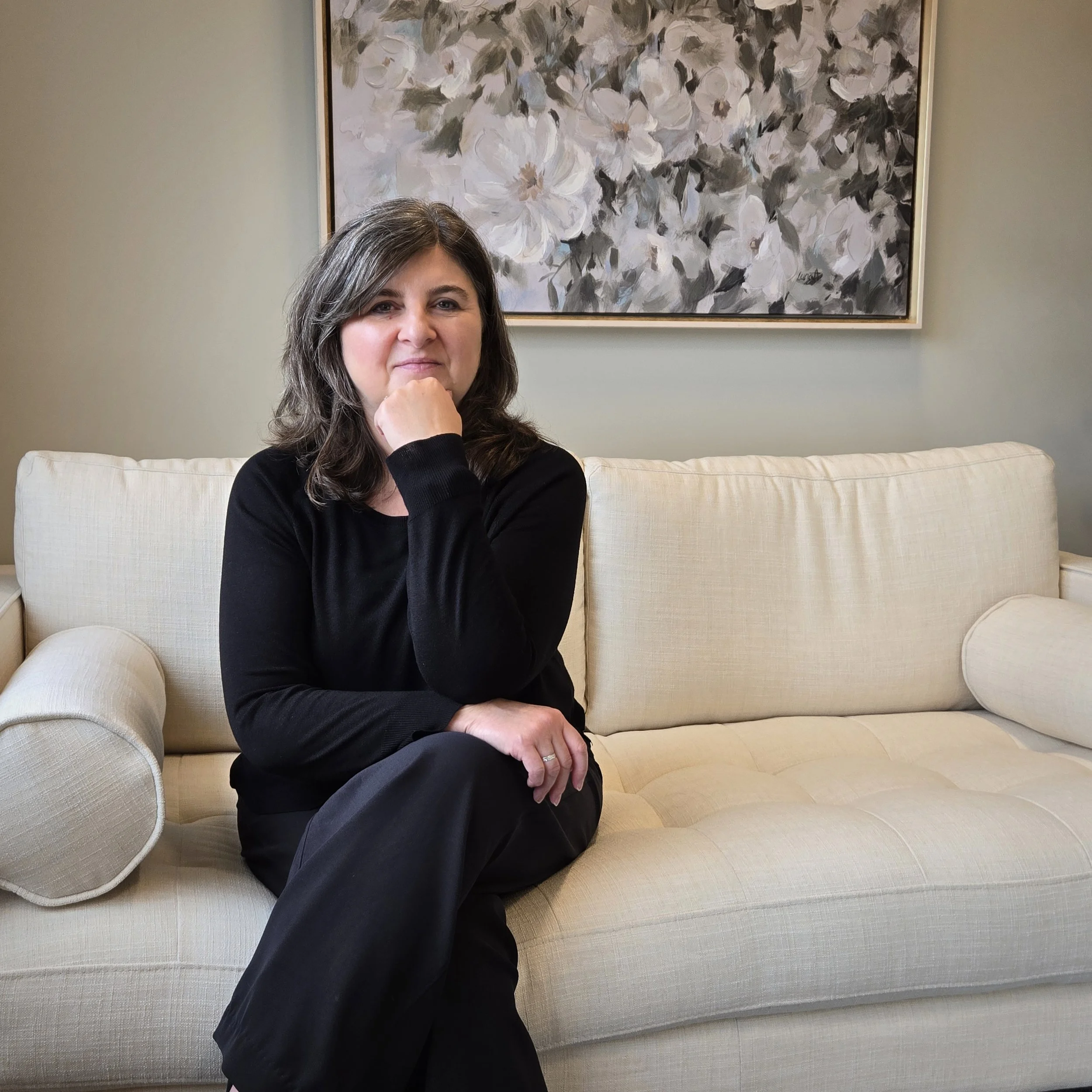
Hi, I’m Lara.
Meet Lara, Trusted Therapist in Calgary SW
I work with people who feel caught in patterns of intrusive thoughts, doubt, compulsions, avoidance, anxiety , or the constant need to feel certain.
Sometimes you know exactly what you'd like to change. Other times, you may simply notice that you're spending more and more time checking, analysing, seeking reassurance, or trying to make uncomfortable thoughts and feelings go away.
My approach is practical, supportive, and tailored to you. Using Exposure and Response Prevention (ERP), we can work together to better understand the patterns that may be keeping OCD going and practise new ways of responding to intrusive thoughts, uncertainty, and compulsive urges.
Whether OCD has been affecting your life for years or you've only recently started noticing patterns that are becoming difficult to manage, we can start with what is happening for you now.
I'm glad you're here.
Exposure and Response Prevention Therapy in Calgary: FAQs
-
ERP is essentially a specialized, highly targeted form of CBT. Where CBT challenges or changes the validity of negative thoughts, ERP focuses on changing your reaction to intrusive thoughts by learning to tolerate uncertainty.
-
Yes! Change is more likely to occur by doing intentional homework in between sessions.
-
No, you are always in control. I work alongside you as a collaborator. Once we create a ladder of your triggers and fi nd your distress levels, you actually choose what you want to work on. Starting small is recommended and you have the freedom to either step back, break things down into smaller steps, or choose a diff erent task.
-
Yes, absolutely. In fact, combining ERP therapy and medication can be highly eff ective in treating moderate to severe OCD.
-
You can fill out the contact or Get in Touch form and I will reach out to you with dates and times that I have available. All free consultations are virtual consultations.
-
Most insurance companies will cover psychology services. You may have to reach out to your insurance company to ask about what is covered.
Specifics You Need to Know About Therapy in Calgary
Office location
Suite #214,
30 Springborough Blvd SW
Calgary, AB
Cost per session
Individual (50 min sessions) - $210
Couples/parents (50 min sessions) - $210
Payment options
E-Transfer
Credit Card
Debit Card
In-Person and Virtual Appointments available
In-Person and Virtual Appointments available
Exposure and Response Prevention Therapy Calgary SW
Start Today with a Free Initial Consultation!
If you're wondering whether ERP therapy could be a good fit for you, you're welcome to book a free 15-minute consultation.
It's a chance to ask questions, share a little about what you've been experiencing and learn more about how I work with OCD using ERP.
You don't need to know exactly where to start. We can begin with a conversation and see what feels right for you. Book your free consultation and take the first step.
I look forward to talking to you!
Lara Palset